
ARMENIA & AZERBAIJAN: TWO PARTNERSHIPS, TWO EUROPES? When the defense of values clashes with the logic of energy security
Alexis Rochette-Krikorian

In early May 2026, two significant diplomatic events occurred within hours of each other in the South Caucasus region in Armenia & Azerbaijan. On May 5, France and Armenia signed a declaration in Yerevan establishing a strategic partnership based on political, security, economic, and cultural cooperation grounded in international law, the rule of law, and democratic principles. The previous day, in Baku, Italy formalized its own strategic partnership with Azerbaijan, building on a rapprochement that began in 2020 and focuses on energy infrastructure, industrial cooperation, and defense technologies.
While these two initiatives are formally comparable, they nevertheless reveal two distinct conceptions of the role Europe intends to play in the region.
I. Symmetry of Form, Asymmetry of Foundations
At first glance, the two partnerships appear to have a similar structure, including political dialogue, economic cooperation, defense, culture, and education. However their foundations differ significantly.
The Franco-Armenian declaration[1] explicitly grounds the bilateral relationship in respect for the United Nations Charter, the Helsinki Final Act, the rule of law, fundamental freedoms, and democratic consolidation. Notably, it stipulates Armenia’s commitment to ratifying the Istanbul Convention to combat violence against women, as well as bilateral cooperation to strengthen democratic institutions and combat corruption.
An entire section is devoted to cooperation between the two countries in "combating foreign information manipulation," which is a transparent reference to the information war waged by Russia. France is now strongly engaged in this fight through initiatives such as "French Response." The paragraph also emphasizes the two countries' collaboration within the "International Partnership for Information and Democracy," launched in 2019 at the initiative of France at the United Nations. This partnership unites 57 countries and aims to regulate influential information platforms and combat propaganda from authoritarian states. Therefore, one can hope—though perhaps not with too much conviction—that this paragraph addresses not only the Russians, but also the information war waged by Azerbaijan and Turkey against the Armenians. The motivations behind this war merit a separate analysis.
Unlike the Franco-Armenian declaration, the full text of the Italian-Azerbaijani partnership is not publicly available. Signed in Rome on February 20, 2020, by Ilham Aliyev and Giuseppe Conte (the Italian prime minister at the time), it was signed seven months before Azerbaijan launched the 44-day war. The document is titled "Joint Declaration on Strengthening the Multidimensional Strategic Partnership between the Republic of Azerbaijan and the Republic of Italy."
However, we do know that the Italian public statements about its partnership with Baku make no mention of democratic conditions, human rights, or the rule of law. Yet Azerbaijan ranks at the bottom of international rankings regarding press freedom and political rights. For example, Azerbaijan ranks 171st out of 180 countries in Reporters Without Borders’ 2026 World Press Freedom Index.
This choice is significant. It reflects a diplomatic trade-off that prioritizes energy and industrial continuity over normative standards and human rights. It also underscores the persistent conflict between the European Union’s professed commitments and the imperatives perceived as strategic that have shaped its energy policy since 2022.
As Leonardo, the partially state-owned defense group that delivered military aircraft to Baku, put it: Italian-Azerbaijani defense cooperation is “initially linked to the energy sector[2] .” Energy takes precedence over values. Access to gas dictates foreign policy.
II. Two Approaches to Regional Security
Since 2022, France has built an unprecedented defense partnership with Armenia, including the training of Armenian army units by French instructors deployed on the ground[3], the delivery of surveillance radars, and a 2024 contract for 36 Caesar howitzers[4]. The May 5 declaration formalizes this partnership, including defense industrial cooperation, joint military R&D, cybersecurity, and support for Armenian participation in international peacekeeping missions, particularly within the framework of the European Union’s Common Security and Defense Policy.
Italy, for its part, has delivered C-27J Spartan military transport aircraft to Azerbaijan (Leonardo, first delivery in June 2024[5]). During Meloni’s visit on May 4, 2026, Aliyev spoke of “a new chapter in military cooperation” with Rome. He noted that discussions focused on areas in which “Italy has technology” and on “concrete ways to develop this cooperation.” Meloni confirmed Italy’s desire to strengthen the partnership in the fields of aerospace, maritime security, critical infrastructure protection, and cutting-edge technologies. She described the proposed model as “cooperation between industrial systems” involving the transfer of expertise and joint development, capable of “promoting regional stability[6].”
The two parties thus appear to have laid the groundwork for a deepened, long-term industrial relationship, backed by the considerable resources of Azerbaijan’s State Oil Fund and the commercial appetite of a rapidly expanding Italian defense industry.
While France is currently supplying defense equipment to a country that remains under existential threat, Italy appears to have chosen to deepen structural industrial cooperation with a country that, according observers such as Freedom House[7], has carried out ethnic cleansing in Nagorno-Karabakh.
The nature of the cooperation undertaken by France and Italy has political significance that goes beyond its technical aspects.
III. Armenian Heritage: France Documents, Italy Rebuilds Over It
Perhaps the Franco-Italian divergence is most symbolically evident in the realm of heritage.
The Franco-Armenian declaration dedicates an entire article (Art. 5.5) to cooperating on “the preservation of cultural heritage, particularly within the framework of UNESCO and the International Alliance for the Protection of Heritage (ALIPH).” This is not just a formal clause. It can be seen as an indirect response to the destruction of Armenian heritage in territories that have come under Azerbaijani control, a phenomenon that international NGOs have documented for over 20 years. Why “indirect”? Because Franco-Armenian cooperation via ALIPH can only occur within the sovereign territory of the Republic of Armenia. ALIPH has neither jurisdiction nor access to the former territories of Nagorno-Karabakh, now under Azerbaijani administration, where the destruction or unlawful alteration of buildings is actually taking place. This limitation is real, and intellectual honesty demands that we acknowledge it. However, it does not detract from the symbolic and political value of the Franco-Armenian commitment, especially since nothing comparable exists in the Italian-Azerbaijani partnership. Nevertheless, it demonstrates the concrete scope of the action that Europe can still take.
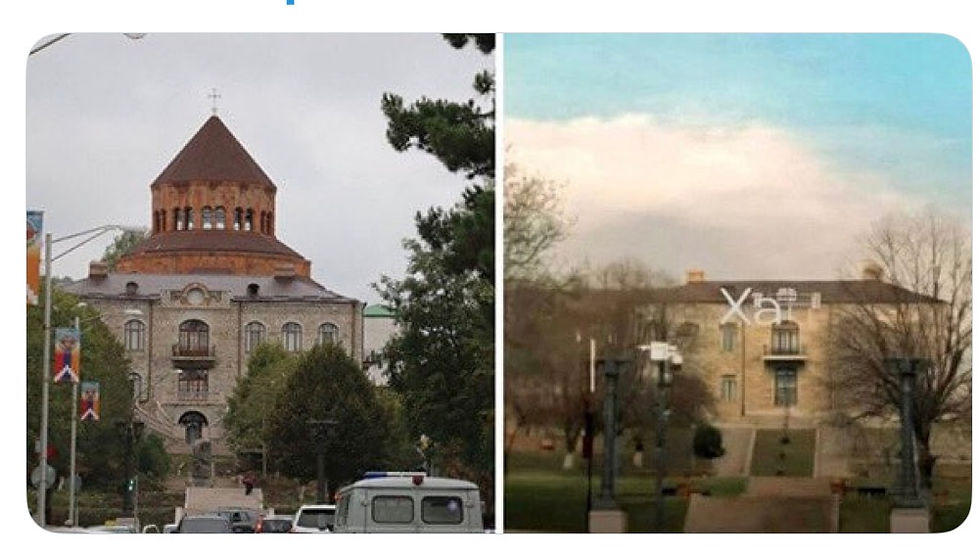
The evidence of destruction in Nagorno-Karabakh is overwhelming. Before-and-after satellite images reveal the demolition of St. John the Baptist Church in Shushi[8] and, more recently, that of St. James Church in Stepanakert[9] . Many other religious buildings have been damaged, including Ghazanchetsots Cathedral in Shushi and the fifth-century Tsitsernavank Monastery. On the eve of the Armenian Genocide Remembrance Day in April 2026, satellite images confirmed the destruction of Stepanakert Cathedral.
In the face of destruction, UNESCO did not react. This was partly due to Azerbaijan denying access to independent observation missions, and partly due to its most influential members choosing not to press the issue. This institutional silence exemplifies the broader phenomenon of the “toxic neutrality” of major international organizations. By refusing to take a stance in the face of documented destruction, these organizations are not remaining neutral; they are endorsing the status quo.
Italy’s position reveals its true nature: no longer mere passive complicity, but active participation, albeit not always acknowledged. Indeed, during Meloni’s visit on May 4, 2026, the two sides agreed to increase the presence of Italian companies in the “reconstruction of Karabakh and East Zangezur.” During the joint press conference with Meloni, Aliyev himself stated that 23 projects are currently being implemented in Nagorno-Karabakh with Italian partners[10]. According to Azerbaijani sources, Italy plays “a leading role” there. Among these projects, according to Azerbaijani sources, is the design of “Victory Museums,” such as the one in Shushi, for example, whose design was reportedly entrusted to the Italian company ArtCloud Network International[11]. This brings to mind the “Victory Park” in Baku, where mannequins depicting captured Armenian soldiers were displayed as war trophies. This site has been repeatedly condemned by human rights organizations. While Azerbaijani bulldozers are razing Armenian churches and a cathedral, it seems that Italian companies are building or preparing to build monuments to replace them.
In late April, a few days after the destruction of the Stepanakert Cathedral, the Vatican and the Heydar Aliyev Foundation (an Azerbaijani state institution that serves as a vehicle for soft power throughout Europe, including in France) announced that they had reached an agreement regarding the restoration of four statues at the Basilica of St. Paul Outside the Walls. According to the Vatican City State government's official website: “This donation is a testament to the strong friendship and mutual cooperation that unite the Vatican and Azerbaijan[12].” The Aliyev Foundation has funded other restoration projects, including statues in Vatican museums, manuscripts in the Vatican Apostolic Library, and bas-reliefs[13], with a total investment exceeding one million euros according to Italian media[14]. These investments are presented as a contribution by the Muslim world to preserving Christian heritage[15]. However, they are not merely philanthropic: they also symbolize a carefully maintained diplomatic silence. While Armenian heritage is disappearing stone by stone - let us recall here that the Armenian heritage of Nakhichevan was completely destroyed in a systematic campaign from 1997 to 2011[16] - the Aliyev Foundation is restoring Christian heritage in Rome. The symmetry is perfect. And perfectly cynical.
There has been no Italian official statement condemning the destruction of Armenian heritage in Nagorno-Karabakh. During the joint press conference on May 4, 2026, Meloni did not utter the word “heritage[17]” even once. Aliyev pointed out that 23 Italian projects were underway in these territories from which an entire indigenous population had just been driven out. Meloni did not deem it necessary to distance herself.
Satellite imagery and various independent heritage monitoring programs have documented the destruction, which justifies the immediate authorization of an international independent assessment mission, at the very least.
IV. Neutrality as Complicity
It would be inaccurate to portray Italy as an isolated voice. Several European capitals share complacency toward Baku, and the European Union itself signed a memorandum of strategic energy partnership with Azerbaijan in 2022. In July 2022, between the 44-day war and the start of the blockade of Nagorno-Karabakh, a prelude to the ethnic cleansing of fall 2023, Commission President Ursula von der Leyen described Azerbaijan as a “reliable partner.”
However Italy occupies a special place in this situation. It is, by far, the largest European importer of Azerbaijani energy. It is Baku’s most advanced Western defense partner. It is now positioning itself as Azerbaijan’s “privileged gateway” to the European market[18], in Meloni’s own words.
Yet it is this same Azerbaijan that, emboldened by this support, has imposed the principle that “might is right” on the Armenian people and their heritage. Millennia-old places of worship have been destroyed. Cemeteries have been destroyed, khachkars have been desecrated, and monasteries have been damaged. This destruction is not mere collateral damage: it is part of a documented policy of systematic De-Armenianization. From Nakhchivan to Nagorno-Karabakh.
In this context, Italy’s neutrality does not simply reflect a balanced stance. It is a choice. This choice comes at a cultural, historical, and civilizational cost that the Armenian people are paying, stone by stone.
V. Two Europes facing off. Even if neither is innocent
To be clear, neither France nor Italy did anything substantial to prevent the catastrophe of 2023. France brought the blockade to the attention of the UN Security Council twice, in December 2022 and August 2023, but did not achieve any concrete results. During the ten-month blockade of the Lachin Corridor, when 120,000 people were deprived of food, medicine, and freedom of movement, Europe chose not to organize an airlift to help the population under siege. They also chose not to impose sanctions on Azerbaijan. This was despite the fact that the International Court of Justice had ruled that the blockade of Nagorno-Karabakh was illegal[19], and Amnesty International—usually reticent on Armenian issues—called for the lifting of the blockade[20]. This inaction was not inevitable; targeted sanctions could have had a significant impact on a state whose hydrocarbon sector accounts for over 90% of total exports[21]. They were not imposed. Not even after the ethnic cleansing in September 2023. As implausible as it may seem, Emmanuel Macron thus declared at the European Political Community Summit in Granada on October 5, 2023, that “the time was not right for sanctions” against Azerbaijan[22].
This fact deserves to be stated plainly: Azerbaijan is not subject to any sanctions, restrictive measures, or conditionality mechanisms, as confirmed by the European Union’s official sanctions map (sanctionsmap.eu). For a state with such a well-documented history of violations of human rights and international law, this absence is remarkable. This is true despite the fact that the International Court of Justice declared the blockade illegal. Nor is it subject to sanctions for the war launched by Azerbaijan in September 2020.Nor for the 2022 incursions into internationally recognized Armenian territory. Nor for the ethnic cleansing in September 2023. Nor for the systematic destruction of Armenian heritage in Nakhchivan, nor for that which began in Nagorno-Karabakh—destruction widely documented by independent entities such as the Caucasus Heritage Watch[23].
Since 2021, the European Parliament has adopted several resolutions condemning these acts of destruction. However, these resolutions are considered “soft law” because they do not provide for any enforceable sanctions, conditionality, or automatic triggers in the event of continued demolitions, which are highly probable. The events of the week of April 30, 2026, illustrate this theatricality with clinical precision.
On April 30, the European Parliament (EP) adopted a new resolution in support of “Armenian democratic resilience[24].” The resolution “condemns the arbitrary detention” of Armenian prisoners and calls for their “immediate and unconditional release.” The resolution also calls for the right of return for Armenians from Nagorno-Karabakh to be established, accompanied by “appropriate international guarantees.” Finally, the resolution “demands accountability for those responsible for the destruction of Armenian cultural and religious heritage and recommends dispatching an international assessment mission.” The next day, the EU ambassador in Baku was summoned to the Azerbaijani Ministry of Foreign Affairs, which described the allegations regarding the destruction of heritage as “completely unfounded and unacceptable.” Also on May 1st, the Milli Mejlis (the Azerbaijani “parliament,” the very same body which had adopted a declaration in March 2023 describing the Armenian diaspora as “a cancerous tumor of Europe[25]”) adopted a resolution suspending all cooperation with the EP in all areas and initiated the procedure to withdraw from the Euronest Parliamentary Assembly. On May 4, at the European Political Community summit in Yerevan, Aliyev, speaking remotely, attacked the EP, denouncing its “obsession[26]” with Azerbaijan. Roberta Metsola, President of the EP, replied: “We will never change our way of working, nor our positions[27]” The next day, Meloni was in Baku.
The mechanism is transparent. During his speech at the European Political Community Summit in Yerevan, Aliyev made a point to differentiate the EP, which he criticized, from the European Commission, which he praised for its “efforts.” This is the same Commission that just approved SOCAR’s acquisition of Italiana Petroli[28]. Baku does not fear resolutions; it absorbs them and turns them into a victim narrative while continuing to roll out its expansion agenda. This agenda includes:
- the definitive De-Armenianization of Nagorno-Karabakh,
- increased gas exports to Europe via Greece, Albania, and Italy,
- a land link between Azerbaijan, Nakhchivan, and Turkey through southern Armenia (the TRUMP route).
What Baku closely monitors is the boundary between soft and hard law. This boundary has never been crossed. Not once.
The absence of sanctions stems from a deliberate political choice, built up over a long period by powerful energy interests and remarkably effective lobbying. Tony Blair is one of the most eloquent symbols of this. As a consultant paid by the Trans Adriatic Pipeline consortium (in which SOCAR, Azerbaijan’s state-owned oil company, is a stakeholder), he traveled to Rome in 2018 to convince the Italian government not to block the project during a meeting with Matteo Salvini, then Minister of the Interior. [29].
In this context, Russia’s responsibility is even more serious. It falls under international law and constitutes a crime of omission. Russia was not merely a bystander. It was a guarantor of the 1994 ceasefire within the framework of the Minsk Group, and, above all, of the trilateral agreement of November 9–10, 2020, which provided for the deployment of Russian soldiers as peacekeeping forces in Nagorno-Karabakh. Russia stood idly by. First, during the December 2022 blockade of Nagorno-Karabakh, and again during the fall 2023 ethnic cleansing of Nagorno-Karabakh.
Now, let's return to Europe. The May 2026 partnerships do not tell us who did what before and during the disaster. Rather, they reveal what each side chooses to do afterward. In this regard, the divergence between Paris and Rome is clear and well-documented.
France has learned its lessons. Imperfectly and belatedly, but genuinely. France has launched concrete defense cooperation with Armenia and signed a partnership based on shared values, such as human rights, the rule of law, and the protection of cultural heritage. France also supports Armenia’s presidency of COP17. While this is insufficient, it represents a measurable shift in the right direction. However, it also carries the risk of supporting an illiberal drift by the Pashinyan government.
The current Franco-Armenian partnership framework could be a first step. Historically, strategic commitments are built in stages, rarely through a single founding act. Military alliances begin with exchanges, then training and arms contracts, and eventually, mutual defense clauses and permanent military presences. The relationship between France and Greece has followed this pattern. The Franco-Armenian relationship could do the same.
Italy, on the other hand, is heading in the opposite direction. The most recent news provides the clearest illustration of this trend. SOCAR, Azerbaijan’s state-owned oil company, has just finalized the acquisition of 99.82% of Italiana Petroli[30], one of Italy’s leading fuel distributors, with the approval, as we have seen, of the European Commission. This Italian company owns refineries and 4,500 gas stations in Italy. Azerbaijan is no longer just a gas supplier to Europe: it is becoming a key player, owning refining and distribution infrastructure on European soil, as is already the case in Switzerland, where SOCAR operates some 200 gas stations and has signed a franchise agreement with Migrolino, a Migros brand. This partnership has been denounced by Swiss associations and federal elected officials[31]. In March 2026, the Committee for the Defense of the Rights of the People of Nagorno-Karabakh and the Swiss-Armenian Association (ASA) filed an official complaint with the State Secretariat for Economic Affairs (SECO) against SOCAR Trading SA. They accused SOCAR of providing financial support to a state responsible for the ethnic cleansing of Nagorno-Karabakh, in violation of the OECD Guidelines[32]. Meanwhile, an analyst at the Topchubashov Center in Baku bluntly states that the transaction positions Azerbaijan “no longer simply as a supplier, but as a structural pillar of the European energy security architecture[33].”
In this context, Aliyev’s statement on May 10, 2026, during a public meeting with residents of Zangilan—a town located very close to the Armenian border—must be understood. Without diplomatic caution, he addressed his own people, stating that if “Armenian political circles driven by deep hatred toward the Azerbaijani people and state were to come to power, it is the Armenian people who would suffer the consequences[34].” The leader of a UN member state, and “reliable” partner of the European Union, publicly issued a barely veiled threat against the population of a sovereign neighboring country on the eve of its parliamentary elections. Under other circumstances, such a statement would prompt the summoning of ambassadors. Here: nothing, niente. Silence.
VI. Conclusion
The European Parliament cannot impose sanctions. However, it can create political pressure, which is necessary for the Council to act. To do so, the EP must adopt resolutions that clearly state the facts, explicitly call for targeted sanctions against those identified as responsible for ethnic cleansing, the continued detention of Armenian prisoners, or the destruction of Armenian heritage and ethnic, and define thresholds that would obligate the Council to act. However, current resolutions do not do this. They are watered down during the intergroup negotiation process to the point of losing any real capacity to exert pressure. Parliamentary groups have tried. The S&D Group and the Greens/EFA Group have put explicit calls for sanctions in writing. They have not been heard.
Europe must ask itself: Can its normative credibility survive in the long term if it fails to enforce its own principles? For the South Caucasus, as for the European idea itself, this issue cannot remain unresolved indefinitely.
[2] https://www.leonardo.com/en/press-release-detail/-/detail/08-06-2023-leonardo-contract-signed-for-c-27j-to-the-azerbaijan-air-force
[3] https://www.forcesoperations.com/la-cooperation-de-defense-franco-armenienne-reaffirmee-a-erevan/
[6] https://www.agenzianova.com/fr/news/L%27Azerbaïdjan--l%27Italie--Aliyev-et-Meloni-relancent-leur-partenariat-dans-le-domaine-de-l%27énergie-et-de-la-défense-et-organiseront-prochainement-un-forum-d%27affaires-à-Bakou./
[7] https://freedomhouse.org/article/new-report-azerbaijani-regime-ethnically-cleansed-nagorno-karabakh-according-international
[8] https://www.rferl.org/a/azerbaijan-armenia-nagorno-karabakh-heritage-destruction-karintak-dasalti/32918998.html
[9] https://www.rferl.org/a/cathedral-church-demolished-nagorno-karabakh-azerbaijan-armenia-conflict/33743489.html
[10] https://www.agenzianova.com/fr/news/L%27Azerbaïdjan--l%27Italie--Aliyev-and-Meloni-revive-their-partnership-in-the-fields-of-energy-and-defense-and-will-soon-host-a-business-forum-in-Baku./
[12] https://www.vaticanstate.va/en/news/4131-the-heydar-aliyev-foundation-and-the-governorate-of-the-vatican-city-state-have-signed-an-act-of-donation.html
[13] https://tribunechretienne.com/entre-destruction-et-mecenat-le-double-jeu-de-lazerbaidjan-avec-le-patrimoine-chretien/
[14] Id
[16] https://www.lejournaldesarts.fr/patrimoine/au-nakhitchevan-lazerbaidjan-detruit-98-du-patrimoine-armenien-162524
[17] https://www.governo.it/en/articolo/president-meloni-s-press-statement-president-aliyev-azerbaijan/31742
[18] Id
[19] https://www.rferl.org/a/azarbaijan-un-court-unblock-lachin-corridor-karabakh-armenia/32283560.html
[20] https://www.amnesty.org/fr/latest/news/2023/02/azerbaijan-blockade-of-lachin-corridor-putting-thousands-of-lives-in-peril-must-be-immediately-lifted/
[22] https://www.bfmtv.com/international/europe/haut-karabagh-emmanuel-macron-estime-que-le-temps-n-est-pas-aux-sanctions-contre-l-azerbaidjan_AN-202310050859.html
[27] Id.
[28] https://www.agenzianova.com/fr/news/La-Commission-européenne-autorise-l%27acquisition-par-SOCAR-de-l%27entreprise-italienne-Petroli/
[29] https://www.theguardian.com/politics/2018/sep/03/tony-blair-matteo-salvini-trans-adriatic-pipeline-gas
[30] https://www.euro-petrole.com/completion-of-the-acquisition-of-italiana-petroli-ip-by-socar-n-i-30064
[31] https://www.heidi.news/suisse/migros-ne-peut-exclure-que-du-petrole-russe-est-vendu-dans-les-stations-suisses-migrolino


Comments