
Armenian Genocide: April 24, 2027 Has Already Begun
Alexis Rochette-Krikorian
On that day, Pashinyan, still in power, issues a statement about the "Meds Yeghern" without once mentioning the word "genocide" or naming those responsible for it. The Genocide Museum has been renamed the "Meds Yeghern Museum."
Science fiction? Not entirely.
Preparing the Ground
His April 24, 2026 statement is telling: in a 540-word text, Pashinyan uses the term "genocide" only twice, compared to five references to "Meds Yeghern[1]". This Armenian term, which means “great crime”, has been used by successive American administrations until Joe Biden, and again from Donald Trump, precisely to avoid using the term “genocide”. Pashinyan did not name those responsible for the genocide, instead attributing it to the "international intrigues" of the great powers of the time, and thus appearing to align with a revisionist Turkish perspective. It's as if minds were being deliberately prepared for this outcome.
The signs are mounting. Armenia announced that it would no longer campaign for international recognition of the Armenian Genocide. Subsequently, the director of the Genocide Museum in Yerevan was dismissed after presenting a book on the ethnic cleansing of Nagorno-Karabakh to U.S. Vice President J.D. Vance, which provoked an outcry among academics specializing in the study of genocides. A Pashinyan loyalist was appointed in her place. It's worth noting that Vance deleted a tweet about the Armenian Genocide during his visit to Yerevan earlier in the year. The museum's new leadership posted and then deleted a tweet mentioning Catholicos Garegin II's visit to the Armenian Genocide memorial on April 24[2], which was revealing since Garegin II was excluded from the official ceremony once again. The supreme head of the Armenian Apostolic Church denounced the destruction of Armenian heritage in Nagorno-Karabakh at a World Council of Churches conference in Switzerland last May. Following that conference, Pashinyan launched his controversial campaign to depose Garegin II.
The Baku-Ankara Axis Escalates
In this context, Turkish citizens are traveling to Yerevan and posting photographs on social media of themselves making the Grey Wolves sign, which is a symbol of Turkish far-right denialism. In Turkey, the institutionalization of Armenian Genocide denial has never been more overt. As they have for several years, the authorities have banned all commemoration of the genocide in Istanbul. On April 24, 2026, the Ministry of Foreign Affairs took its denial policy a step further by resorting to the tired principle of accusatory inversion and commemorating the "vulnerable and innocent Turks ruthlessly massacred by Armenians during the events of 1915."

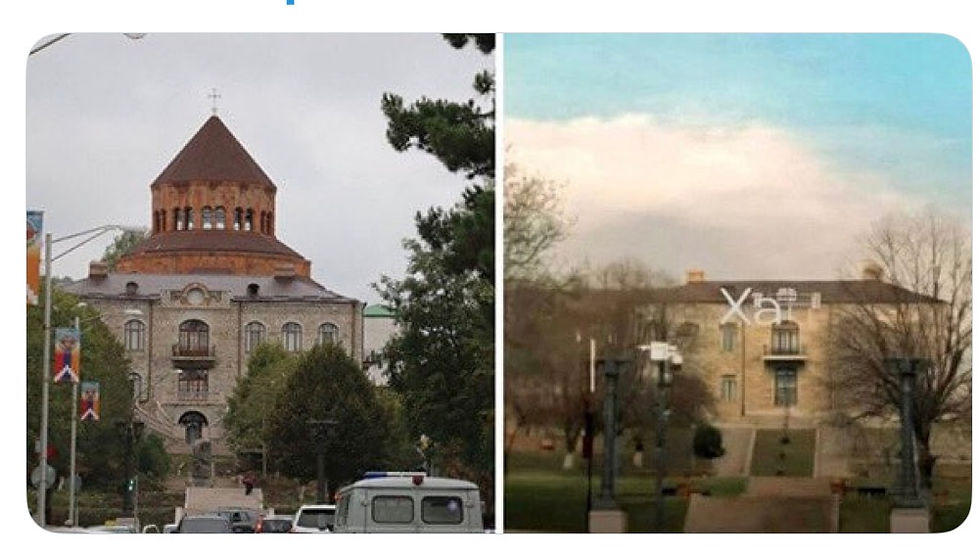
The destruction of the Stepanakert cathedral on the eve of April 24, 2026, follows this same logic — and was not condemned by Armenia, which was anxious not to stir things up. Yet, the Baku-Ankara axis is sending a dual signal. On the one hand, Baku, as it does every April 24, sends a denialist message about erasing all Armenian traces — with impunity. On the other hand, it makes clear that there will be no right of return. The cathedral's basement served as a shelter for the civilian population during Azerbaijan's war of aggression against Nagorno-Karabakh in autumn 2020.

The Omerta on Nagorno-Karabakh
Armenian diplomacy no longer addresses the issue of ethnic cleansing in Nagorno-Karabakh. A Hyestart article had warned of the dangers of such silence. We are now there. It's as if nothing happened between 2020 and 2023, especially between December 2022, when the blockade of Nagorno-Karabakh – deemed illegal by the International Court of Justice – began, and September 2023, when Azerbaijan seized the territory by force and carried out a campaign of ethnic cleansing. When Armenian and Azerbaijani "civil society" groups meet within the framework of the peace process, the Armenian side apparently has no problem with one of the Azerbaijani female representatives having been present at the start of the blockade of the Lachin corridor — assuming the concept of "civil society" has any meaning in an authoritarian state.
Western Governments: Between Commemoration and Inaction
How will France act in this context? Recognition of the Genocide is enshrined in a 2001 law, and April 24 is a recognized day of commemoration in the republican calendar. These are solid achievements. However, the real question is whether there will be enough pressure on France and other countries, such as Greece and Canada, to go beyond commemorative gestures and take concrete action based on this recognition.
On April 24, 2026, ninety-seven French elected officials from across the political spectrum answered this question in an op-ed published in Le Figaro[3]. The officials called for "clearly qualifying the events of 2023, which cannot be reduced to a humanitarian crisis," "working towards targeted European sanctions against those responsible," "guaranteeing the right of return, the protection of civilians, and the safeguarding of heritage" in Nagorno-Karabakh, and "demanding the release of Armenian detainees in Baku." This precise, legally grounded program has received no response to date. The European Political Community (EPC), which will meet in Yerevan in early May, is unlikely to pay any attention to it.
The European Parliament's resolutions on the destruction of Armenian heritage in Nagorno-Karabakh are laudable but remain ineffective as long as they carry no consequences for Azerbaijan. It should be noted that Azerbaijan is one of the few authoritarian regimes against which the EU has not imposed sanctions.
Given Armenia's apparent deference to Washington, particularly regarding the construction of a road connecting Turkic republics through southern Armenia—a project supported by the Trump administration—it is crucial for a future Democratic American administration to fully recognize the Armenian Genocide, as Joe Biden did.
A Sign of Hope from New York
Against this bleak backdrop, the tweet posted by Zohran Mamdani, Mayor of New York, on April 24, 2026, stands as a meaningful counterpoint[4].
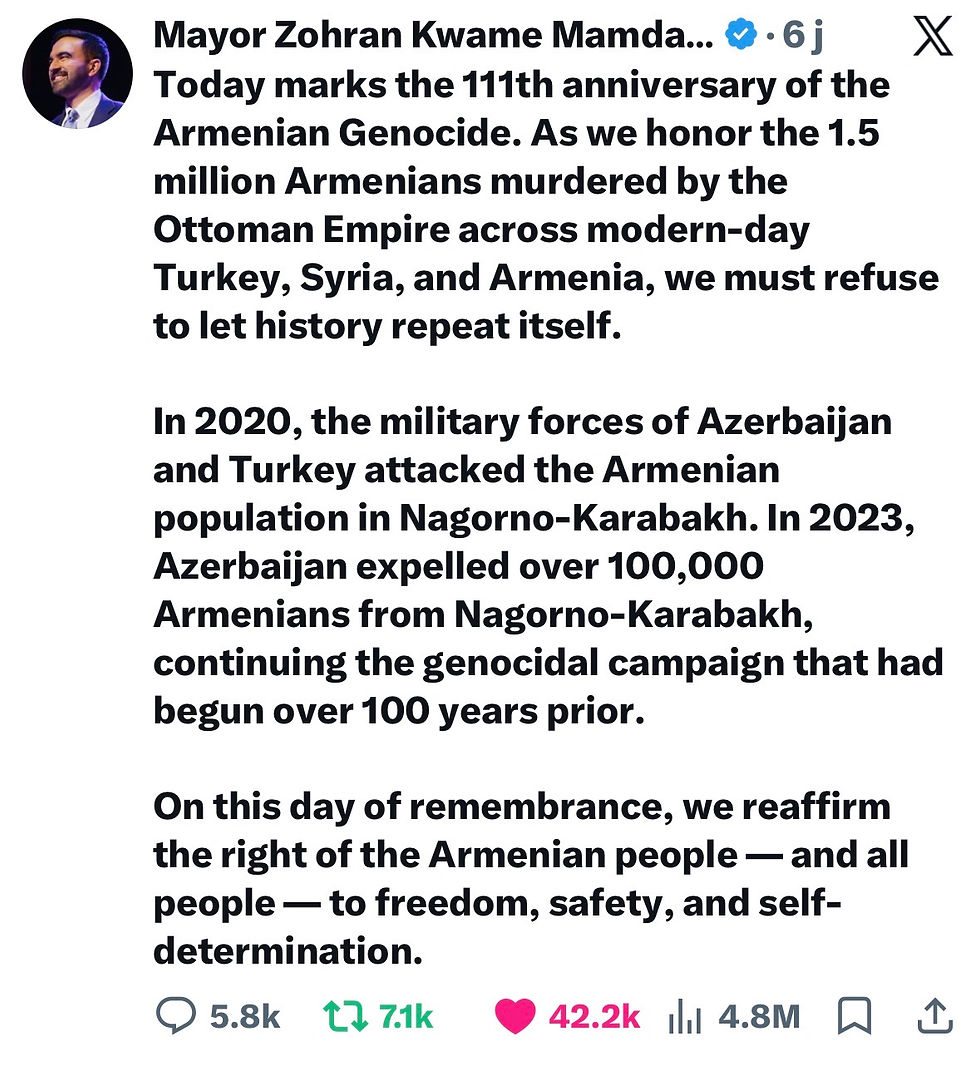
This remarkably clear-sighted text highlights the continuity of the genocidal process from 1915 (in reality dating back to the late nineteenth century) through to the ethnic cleansing of Nagorno-Karabakh in 2023. The message provoked fury among denialists and their supporters, who emphasized the ongoing reconciliation between Turks and Armenians while carefully omitting the reality of the ethnic cleansing of Nagorno-Karabakh, documented notably by Freedom House[5], as well as the recent destruction of the Stepanakert cathedral. Their task is made easier, it must be said, by the Armenian authorities themselves.
What is to be done if this fiction becomes reality?
Armenia is not a dictatorship, and its diaspora does not obey it unquestioningly. In a spirit of emancipation from Yerevan, and as citizens of their respective countries, diaspora members must continue their advocacy around the Armenian Genocide and the consequences that must be drawn from it, even if such efforts will carry less weight without the backing of the Armenian state.
In France, the task will be to ensure that recognition has concrete consequences, in line with the cross-party demands from elected representatives.
In Switzerland, two levers deserve particular attention.
The first is the protecting power mechanism. Since the ICRC office was forced to close in Azerbaijan, there has been no international protection mechanism for Armenian prisoners detained in Baku. Their families are living in complete uncertainty. In response to this situation, they have approached the Armenian and Swiss authorities and the ICRC, requesting that Switzerland assume the role of "protecting power." This mechanism, recognized in international law since 1929, is designed to safeguard the rights of detainees during times of conflict. A protecting power could help ensure regular access to prisoners, complete and translated verdicts, access to independent lawyers, and adherence to the Geneva Conventions. In September 2024, the city of Geneva set an example when it called for the unconditional release of prisoners on the first anniversary of the ethnic cleansing of Artsakh. Now, it is Bern's turn to act. As the guardian of the Geneva Conventions, Switzerland has the legitimacy and duty to assume this role. The families are therefore urgently calling on the Armenian government to formally invite Switzerland to take on this role, which is an indispensable condition for activating the mechanism.
The second is the Swiss Peace Initiative for Nagorno-Karabakh[6]. Following the adoption of Motion 24.4259 by Parliament, the initiative was created and calls on the Federal Council to organize an international peace forum on the Nagorno-Karabakh conflict. The goal is to facilitate dialogue between Azerbaijan and representatives of the Armenians of Nagorno-Karabakh and negotiate the safe return of the historically resident Armenian population. The most recent meeting took place on April 30 in Bern. On this occasion, Christian Solidarity International urged the Swiss President to ensure that the Swiss Peace Initiative is presented at the EPC summit in Yerevan.
Everywhere, the fight must continue for the release of Armenian prisoners and to prevent the Armenian heritage of Nagorno-Karabakh from suffering the same fate as that of Nakhchivan, 99% of which has been destroyed[7].
As Charles Aznavour used to say, the most important thing is for Turkey itself to recognize the Armenian Genocide. Only then will it become a true democracy and a force for peace in the region. However, given the deep institutional entrenchment of the denial policy, we are further from that than ever. Nevertheless, pressure must be maintained, and ties must continue to be built with courageous groups fighting for recognition of the Armenian Genocide by Turkey, such as the Turkish human rights association İHD (İnsan Hakları Derneği[8]). Armenians should advocate for Western governments and NGOs such as Amnesty International to support these groups and their advocacy efforts.
[3] https://www.lefigaro.fr/vox/monde/111-ans-apres-le-genocide-des-armeniens-il-faut-un-droit-international-qui-protege-reellement-les-peuples-20260424
[5] https://freedomhouse.org/article/new-report-azerbaijani-regime-ethnically-cleansed-nagorno-karabakh-according-international


Comments